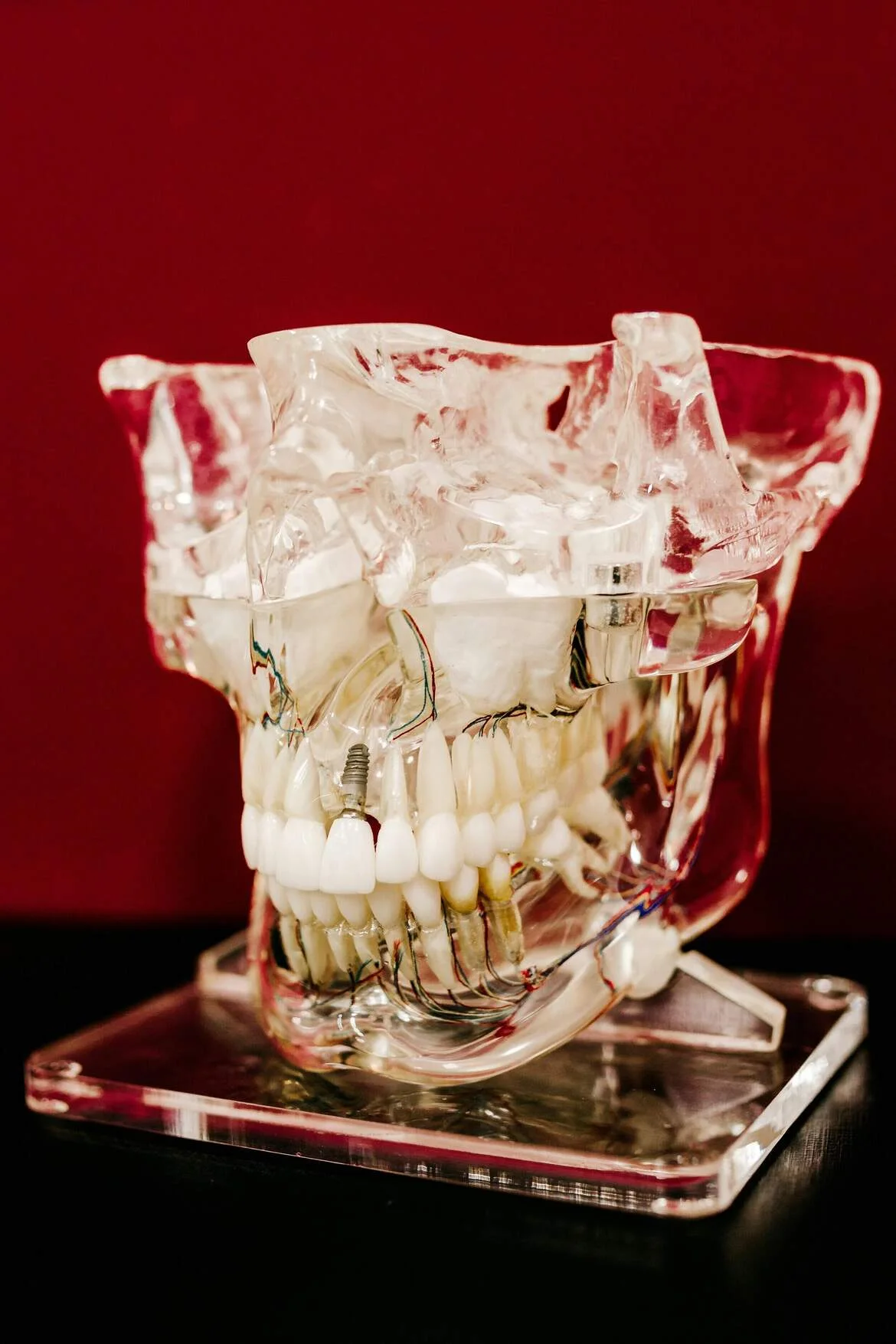
What is a dental implant?
A dental implant is a post placed in the jawbone that does the job of a tooth root. It holds a crown, bridge or denture. The implant and the visible teeth on it are separate parts, and both need ongoing care.
See the sources ↓Get to know the three parts.
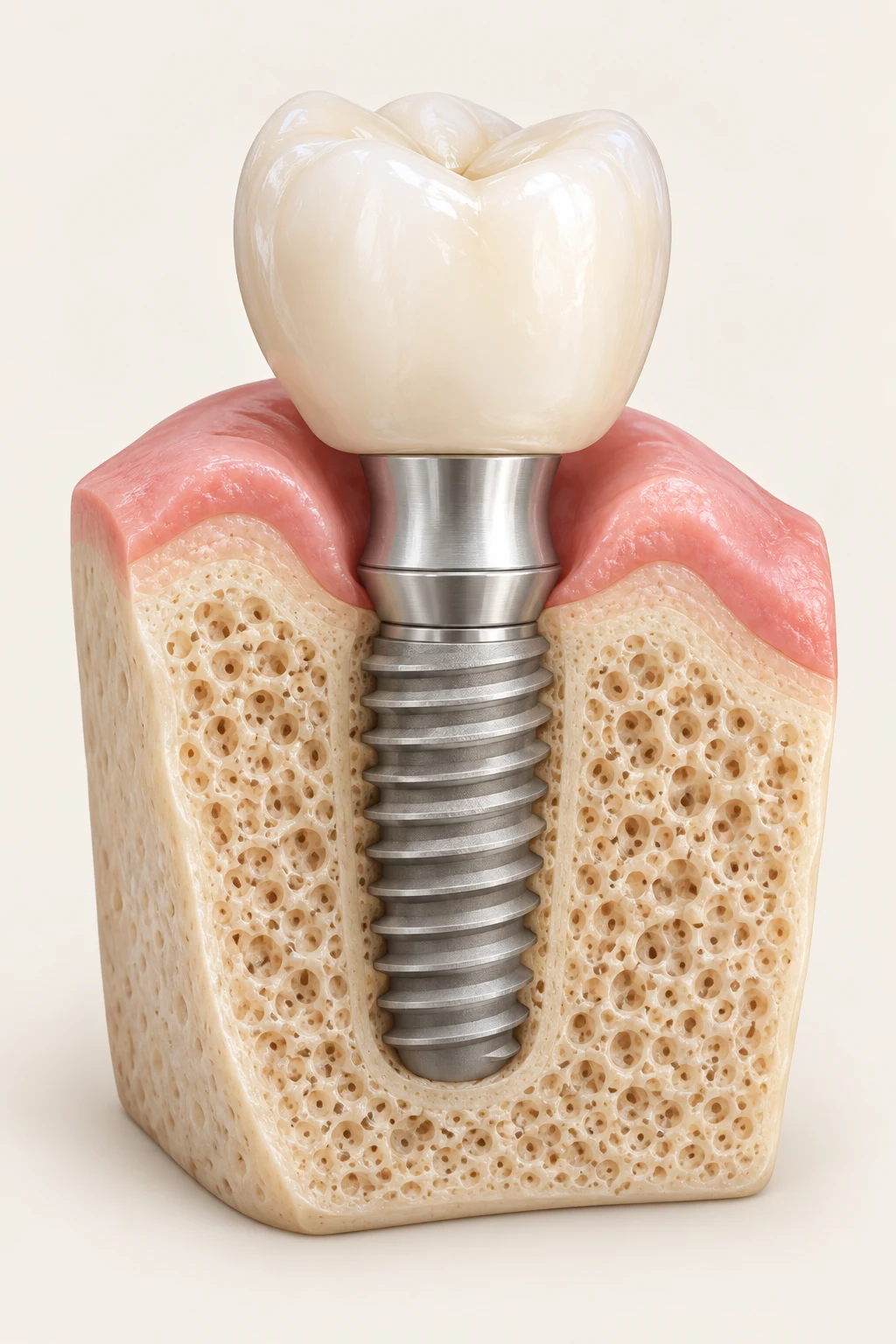
The crown is the visible replacement tooth, shaped to fit the bite and appearance of your smile.
Simplified educational illustration, not to scale.How dental implants work
A dental implant replaces the root of a missing tooth. It's a small post placed in the jawbone, and once the bone has healed around it, it holds a crown, a bridge or a denture in place. The Canadian Dental Association describes it as an artificial root, usually titanium, that integrates with the jaw. That anchor in the bone is the main difference from removable dentures or tooth-supported bridges.
This page covers what an implant is made of, how the parts fit together and what implants are used for. Once that's clear, the different types of dental implants are easier to compare.
What is a dental implant?
It's a post, usually titanium and sometimes zirconia, placed surgically in the jawbone where a tooth is missing. Over the following weeks and months, bone grows onto its surface. That process is called osseointegration, and it's what turns the post into a stable anchor.
Once integrated, an implant can support:
- A single crown to replace one missing tooth
- A bridge to replace several missing teeth in a row
- A full-arch prosthesis to replace all the teeth in an upper or lower jaw
The three main parts of a dental implant
Most implant restorations have three parts:
- The implant fixture. The post in the jawbone. It does the job of a tooth root and carries everything above it.
- The abutment. A connector that attaches to the top of the fixture, usually after healing, and links it to the visible tooth.
- The restoration. The part you see: a crown, bridge or denture, shaped to look and work like natural teeth.
How implants differ from other options
An implant is held in the jawbone. A conventional bridge is held by the natural teeth on either side of the gap, and a removable denture rests on the gums with no fixed anchor.
Because the bone holds it, an implant restoration is generally steadier than a denture, which can affect chewing and comfort. The trade-off is surgery, healing time and ongoing maintenance. The side-by-side guide on how implants compare to bridges and dentures goes through those differences in detail.
Which option fits depends on things a dentist can check: the health of your remaining teeth, the bone where the tooth is missing, your medical history, and what you want from treatment and can budget for.
What dental implants are used for
Common uses include:
- Replacing a single missing tooth with an implant-supported crown
- Replacing several missing teeth in a row with an implant-supported bridge
- Replacing all the teeth in one or both jaws with a full-arch restoration
- Holding a removable denture more securely
- Making chewing easier, which can widen what you're able to eat
- Restoring facial support that may be affected by tooth loss
How long can dental implants last?
In systematic reviews, about 94 to 96 percent of implants were still in place after ten years (Moraschini 2015; Howe 2019). That figure measures survival: the implant remains. It doesn't mean nothing went wrong along the way, and it can't predict what will happen with your own implant.
The crown, bridge or denture on top wears with use and may need adjusting, repairing or replacing over time.
What affects how well an implant does over the years:
- Daily cleaning at home
- Your general health and any conditions that affect healing
- Smoking
- Regular professional check-ups and cleanings
What dental implants do not do
Implants solve some problems and not others. They:
- Don't prevent future problems with your other teeth or gums
- Don't remove the need for daily cleaning
- May not be possible where there isn't enough bone to hold them, unless the bone can be built up first
- Aren't one standard treatment: the number, position and type of restoration are planned for each mouth
Why a consultation is necessary
Only an examination can show whether implants are an option for you. The guide on who is a good candidate for dental implants covers the factors in more depth. At the assessment, a dentist usually looks at:
- The height, width and density of the bone in your jaw
- The health of your gums and surrounding tissues
- Your bite and how your teeth meet
- Your medical history, including anything that affects healing
- Which alternatives would also work, and their trade-offs
If you'd like to know how that appointment runs, see what happens at a dental implant consultation. Once you have an estimate in hand, our guide on how to compare dental implant quotes helps you check what it includes.
Frequently asked questions
What is a dental implant made of?
Most implants are titanium, a metal the jawbone can bond to through osseointegration. Some are zirconia, a ceramic alternative.
How long does it take to get a dental implant?
Usually several months from placement to the final restoration. The time depends on how the bone heals, when your dentist plans to load the implant, and whether you need extra steps such as bone grafting first.
Do dental implants feel like real teeth?
They're anchored in the jaw and can make chewing easier, but they don't have the same sensation as natural teeth. How quickly people get used to them varies.
Questions about your own situation?
Understanding the implant, connector, and replacement teeth can help you discuss a proposed plan.
ImplantOptions.ca is published by Smile Studio Dental, a dental office in Markham. If you'd like to talk through what you've read with a dentist, you can request a consultation. You're also welcome to bring these questions to your own dentist.
References
- Brånemark PI, Hansson BO, Adell R, et al. Osseointegrated implants in the treatment of the edentulous jaw: experience from a 10-year period. Scand J Plast Reconstr Surg Suppl. 1977;16:1-132.
- Buser D, Sennerby L, De Bruyn H. Modern implant dentistry based on osseointegration: 50 years of progress, current trends and open questions. Periodontol 2000. 2017;73(1):7-21.
- Osman RB, Swain MV. A critical review of dental implant materials with an emphasis on titanium versus zirconia. Materials (Basel). 2015;8(3):932-958.
- Moraschini V, Poubel LA, Ferreira VF, Barboza ES. Evaluation of survival and success rates of dental implants reported in longitudinal studies with a follow-up period of at least 10 years: a systematic review. Int J Oral Maxillofac Surg. 2015;44(3):377-388.
- Howe MS, Keys W, Richards D. Long-term (10-year) dental implant survival: a systematic review and sensitivity meta-analysis. J Dent. 2019;84:9-21.
- Esposito M, Grusovin MG, Maghaireh H, Worthington HV. Interventions for replacing missing teeth: different times for loading dental implants. Cochrane Database Syst Rev. 2013;(3):CD003878.
- Canadian Dental Association: dental implants
A useful next question.
“What components are included in my treatment plan?”
See my consultation questions ↗