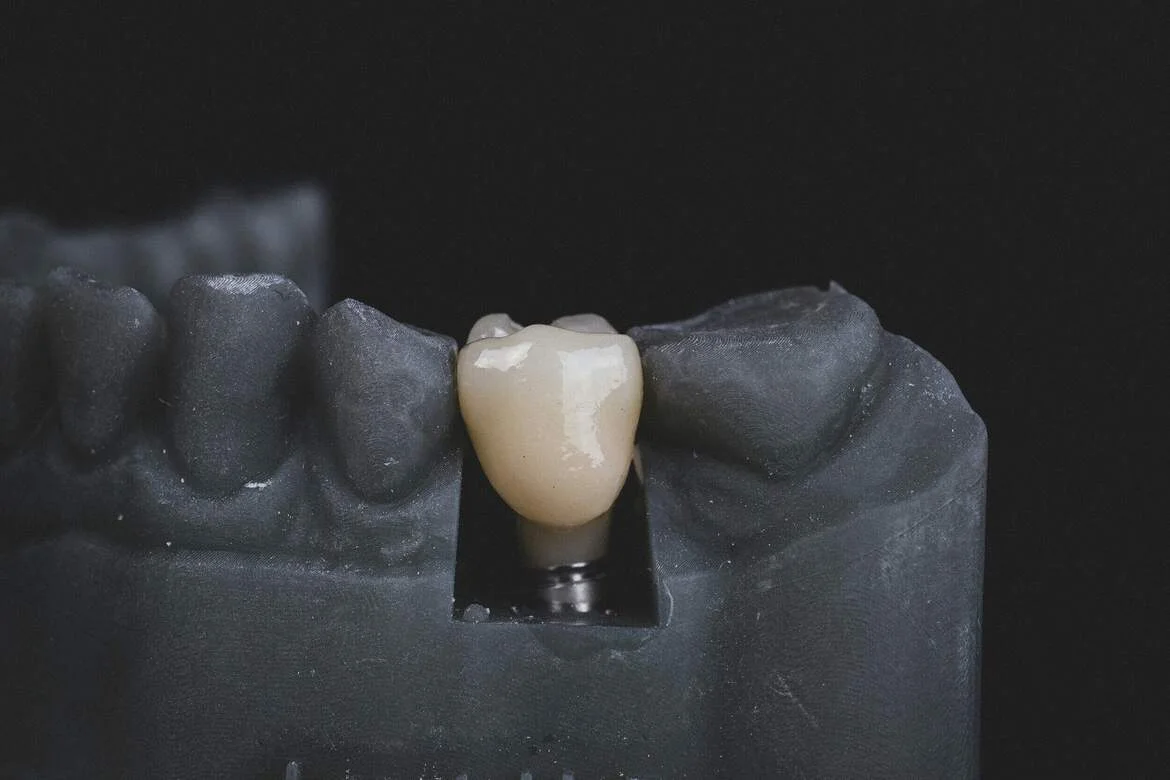
How is one missing tooth replaced with an implant?
One implant, an abutment (connector) and a crown replace the missing tooth without using the neighbouring teeth as bridge supports. Bone, gum condition, bite and appearance shape the plan.
See the sources ↓Get to know the three parts.
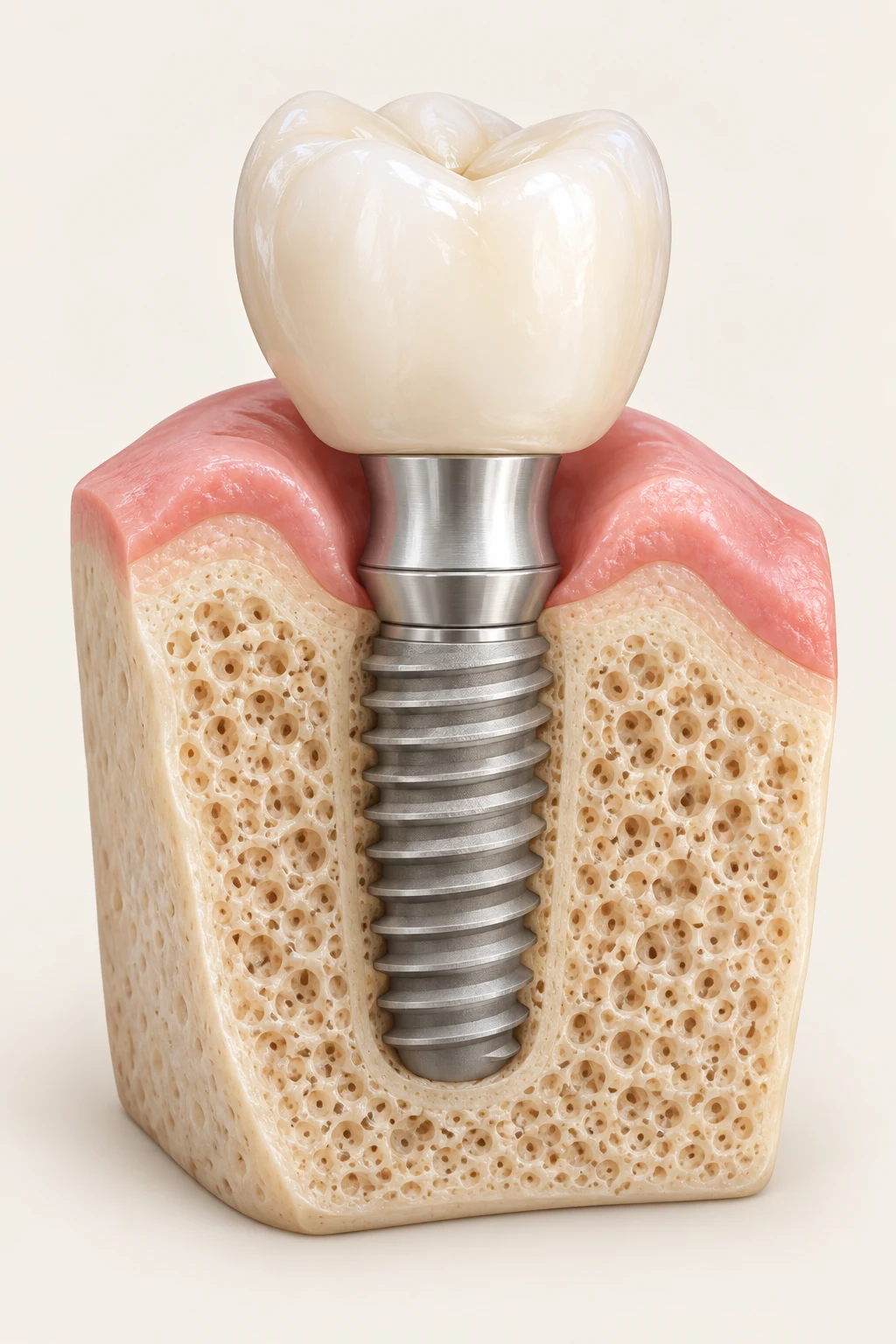
The crown is the visible replacement tooth, shaped to fit the bite and appearance of your smile.
Simplified educational illustration, not to scale.Replacing a single missing tooth
One missing tooth can be replaced with one implant and a crown, without touching the teeth on either side. The implant sits in the jawbone on its own, so the neighbouring teeth don't have to carry it. If implants are new to you, start with what dental implants are and how they work.
Below: when a single implant is considered, how it's built, how it compares with a bridge, and what decides whether it's possible in your mouth.
When a single tooth implant may be considered
It usually comes up when one tooth has been lost and the teeth beside the gap are healthy and don't need crowns of their own.
Typical situations:
- A tooth lost in an accident or injury
- A tooth taken out because of severe decay or infection
- An adult tooth that never developed
- A tooth that has cracked beyond repair
How a single tooth implant works
It happens in stages. A small titanium or zirconia post is placed in the jawbone where the tooth was. Over weeks to months, bone grows onto it (osseointegration) until it's firm enough to load.
Then an abutment is attached and a crown made to match the colour, shape and size of your other teeth goes on top. The finished tooth stands on its own.
Single tooth implants compared to dental bridges
A conventional bridge fills the gap with a false tooth held by crowns on the teeth either side. To fit those crowns, the neighbouring teeth have to be reshaped.
An implant doesn't need them. That matters most when the neighbouring teeth are healthy and unfilled, because reshaping them can't be undone. A bridge, on the other hand, doesn't involve surgery. For the full comparison, see implants vs bridges vs dentures.
Bone and gum considerations
An implant needs enough bone, in both height and width, to hold it. After a tooth is lost, the bone around the gap can shrink over time, so a gap that has been there for a while may have less bone to work with.
The gum matters too. Healthy, settled gum around the site gives the implant a better long-term outlook. Both are examined, usually with imaging, before a single implant is offered.
Timing of placement
Sometimes the implant can go in soon after the tooth comes out. Other times the dentist waits for the bone and gum to settle first.
What decides it: the state of the extraction site, whether there's infection, the quality of the bone, and the rest of the plan.
Longevity and maintenance
Systematic reviews report high survival for implants carrying single crowns over five years of follow-up. Survival isn't the whole story, though. The same reviews track problems such as loose screws, chipped crowns and gum inflammation, which can happen even when the implant stays in place.
What keeps a single implant in good shape:
- Daily brushing and flossing around the implant
- Regular check-ups and professional cleanings
- Avoiding habits that put heavy force on the implant, such as tooth grinding
- Expecting the crown to need adjusting or replacing at some point, from normal wear
Is a single tooth implant right for everyone?
No. Bone, gum health, medical history and habits such as smoking can each rule it out or delay it, and some conditions raise the risk of complications. The guide on who is a good candidate for dental implants explains each factor.
If you're missing more than one tooth in a row, read about multiple tooth implants instead. When you have an estimate, our guide on how to compare dental implant quotes helps you check it covers the implant, abutment and crown.
Questions about your own situation?
The condition of the gap and neighbouring teeth helps determine the options for one missing tooth.
ImplantOptions.ca is published by Smile Studio Dental, a dental office in Markham. If you'd like to talk through what you've read with a dentist, you can request a consultation. You're also welcome to bring these questions to your own dentist.
References
- Jung RE, Zembic A, Pjetursson BE, Zwahlen M, Thoma DS. Systematic review of the survival rate and the incidence of biological, technical, and aesthetic complications of single crowns on implants reported in longitudinal studies with a mean follow-up of 5 years. Clin Oral Implants Res. 2012;23(Suppl 6):2-21.
- Pjetursson BE, Brägger U, Lang NP, Zwahlen M. Comparison of survival and complication rates of tooth-supported fixed dental prostheses (FDPs) and implant-supported FDPs and single crowns (SCs). Clin Oral Implants Res. 2007;18(Suppl 3):97-113.
- Esposito M, Grusovin MG, Maghaireh H, Worthington HV. Interventions for replacing missing teeth: different times for loading dental implants. Cochrane Database Syst Rev. 2013;(3):CD003878.
- Canadian Dental Association: dental implants
A useful next question.
“Could a single implant or a conventional bridge suit this gap?”
See my consultation questions ↗